
 Request for Proposals: Innovative Posts… Request for Proposals: …Request for Proposals: Innovative Posts… Request for Proposals: …
The Innovative Postsecondary Models (IPM) Fund seeks proposals from organizations operating innovative postsecondary education models that are rethinking how education is designed, delivered, financed, and assessed for learners in the United States.
Managed by Panorama Global, the IPM Fund is a donor collaborative funded by Ascendium Education Group, College Futures Foundation, ECMC Foundation, Gates Foundation, the Evelyn and Walter Haas, Jr. Fund, Lumina Foundation, the Raikes Foundation, and Strada Education Foundation.
Through this request for proposals, the IPM Fund will identify and fund high-potential education models that are reimagining how postsecondary education can remove barriers and increase access and improve outcomes for learners across the U.S.
The Fund is interested in innovations that benefit all learners, but especially learners whom the data show encounter the greatest obstacles to opportunity. The goal of this Fund is not only to provide funding to innovative models, but also to learn from selected grantees on how to reduce barriers to postsecondary access and increase student success outcomes to help inform the role philanthropy can play in supporting higher education innovation.
Please note that individual grant amounts within this range will be determined by the applicant review committee based on proposed project activities, the applicant organization's overall budget, and the Fund collaborative's total available grant budget.
We are seeking innovative postsecondary education models that demonstrate, or have the potential to demonstrate, meaningful improvements in how learners access, experience, and benefit from postsecondary education. We seek approaches with the potential to scale, influence the field, and inform how postsecondary education evolves nationally.
To help illustrate the types of innovations we hope to support, we have organized this opportunity around four broad themes. These themes reflect key dimensions of postsecondary innovation that have the potential to improve learner outcomes and inform broader systems change.
All four themes are grounded in a shared principle: student-centeredness. Truly innovative postsecondary models must be designed around learner needs, especially the needs of learners whom the data show face the greatest barriers to access and success in traditional postsecondary education.
Applicants are not expected to address all four themes, but should demonstrate strong alignment with at least one of the following:
What success might look like: Innovative instructional models improve student persistence, completion, and post-completion success, particularly for historically underserved learners, while maintaining or reducing costs. Learners benefit from personalized, adaptive instruction and competency-based assessments that enable them to demonstrate and document skills in ways that are recognized by employers and other educational institutions.
What success might look like: Learners spend less overall, face reduced financial risk, and access high-quality education pathways that lead to credentials supporting economic mobility. Successful models demonstrate affordability not only through reducing costs for learners, but also by maintaining or reducing the cost of delivering high-quality education through sustainable, efficient approaches.
What success might look like: Work and learning are more demonstrably connected and flexible, with evidence that skills are more directly tied to credentials and real career opportunities.
What success might look like: More learners from backgrounds and communities who the data show have faced the greatest barriers to accessing postsecondary education are able to access, complete, and benefit from high-quality credentials.
Selected grantees will work with the Fund to establish shared metrics and reporting frameworks at the start of the grant period.
Please see a preview of the application here: Sample Application Form.
The Innovative Postsecondary Models (IPM) Fund supports innovative postsecondary education models that are rethinking how education is designed, delivered, financed, and assessed for learners in the United States.
Managed by Panorama Global, the IPM Fund is a donor collaborative supported by Ascendium Education Group, College Futures Foundation, ECMC Foundation, Gates Foundation, the Evelyn and Walter Haas, Jr. Fund, Lumina Foundation, the Raikes Foundation, and Strada Education Foundation.
The Fund seeks to support high-potential models that are reimagining how postsecondary education can remove barriers, expand access, and improve outcomes for learners across the United States.
We are seeking innovative postsecondary education models that demonstrate, or have the potential to demonstrate, meaningful improvements in how learners access, experience, and benefit from postsecondary education.
The Fund is particularly interested in models that have the potential to improve learner outcomes, reduce financial barriers, better connect education and employment, expand access for underserved learners, and inform the broader field of postsecondary education.
Proposals should align with at least one of the following areas:
Applicants are not expected to address all four areas.
The Fund is interested in models that meaningfully reimagine traditional approaches to how postsecondary education is designed, delivered, financed, assessed, or connected to employment.
Applicants should be concrete about what their model does differently, how it departs from traditional postsecondary education, why the approach matters for learners, and what barriers it is designed to address.
The Fund is not looking for any one type of institution, technology, or educational model. Innovation may take many forms.
All four areas of interest are grounded in a shared principle: student-centeredness.
The Fund is interested in models designed around learner needs, particularly the needs of learners who face the greatest barriers to accessing and succeeding in traditional postsecondary education.
Applicants should be clear about the barriers their model is designed to address, how those barriers affect their target learners, and how their approach is designed to improve learners' access, experience, and outcomes.
No. Technology and artificial intelligence (AI) are not required for this funding opportunity.
Applicants may describe the role that technology or AI plays in their model, if relevant, including how it may help streamline delivery, improve efficiency, expand access, or support learners.
The Fund anticipates awarding 7–10 grants in the range of $750,000–$1,000,000.
Individual grant amounts will be determined by the application review committee based on proposed project activities, the applicant organization's overall budget, and the Fund's total available grant budget.
Applicants are not required to submit a detailed project budget as part of the initial application. More detailed budget information, including allowable costs and budget assumptions, will be requested from finalists following the review process.
The Fund has not established a specific indirect cost rate for applicants at this stage of the application process. Additional budget guidance will be provided to finalists.
The anticipated grant period is February 2027 through July 31, 2028, approximately 18 months.
Selected grantees will work with the IPM Fund to establish shared metrics and reporting frameworks at the start of the grant period.
Grantees will also participate in shared learning activities, including:
Organizations must meet the following minimum eligibility requirements:
Note: Models primarily producing post-baccalaureate certificates are not eligible.
No. Applicants do not need to be incorporated in the United States. However, the proposed postsecondary model must serve learners in the United States.
No. The Fund will consider applications from a range of organizational structures, including fiscally sponsored organizations, nonprofit organizations, for-profit organizations, and international organizations, provided they meet the eligibility requirements.
Organizations may submit more than one application if they are proposing distinct postsecondary models. Each application should represent a separate model with its own goals, activities, and intended outcomes.
Yes. Organizations with fiscal sponsors are eligible to apply.
Applicants will provide information about both the applicant organization and its fiscal sponsor as part of the application process.
No. Models do not need to directly award credentials to be eligible. The Fund supports innovative approaches that help learners access, progress toward, and obtain postsecondary credentials, including models that operate through partnerships with colleges, universities, employers, credential providers, or other organizations.
Yes. The Fund welcomes applications from eligible organizations advancing innovative postsecondary models, including organizations working in partnership with institutions of higher education or other postsecondary stakeholders.
No. Accreditation is not required to apply.
Accredited organizations should describe what accreditation means for their approach to quality assurance.
Organizations that are not accredited and are not seeking accreditation should explain their rationale and describe how they ensure quality and protect learners.
The proposed model must have ongoing enrollment of learners in programs leading to eligible degrees or credentials of value by March 31, 2027.
Applicants should demonstrate that their model is sufficiently developed and operationally ready to meet this requirement.
Yes. Previous funding or subgrant support from one of the participating funders does not increase or decrease an organization's likelihood of receiving funding through this RFP.
Applicants will be asked to disclose grants or subgrants received from participating funders within the last three years. This information will help the Fund better understand applicants' funding landscapes and will not be used to determine funding decisions.
To ensure a fair and equitable application process, the Fund team is not able to provide individual application guidance or meetings during the open application period. Applicants may submit questions to the Fund team at [email protected].
This is the Fund’s first open application opportunity. Future funding cycles have not yet been determined.
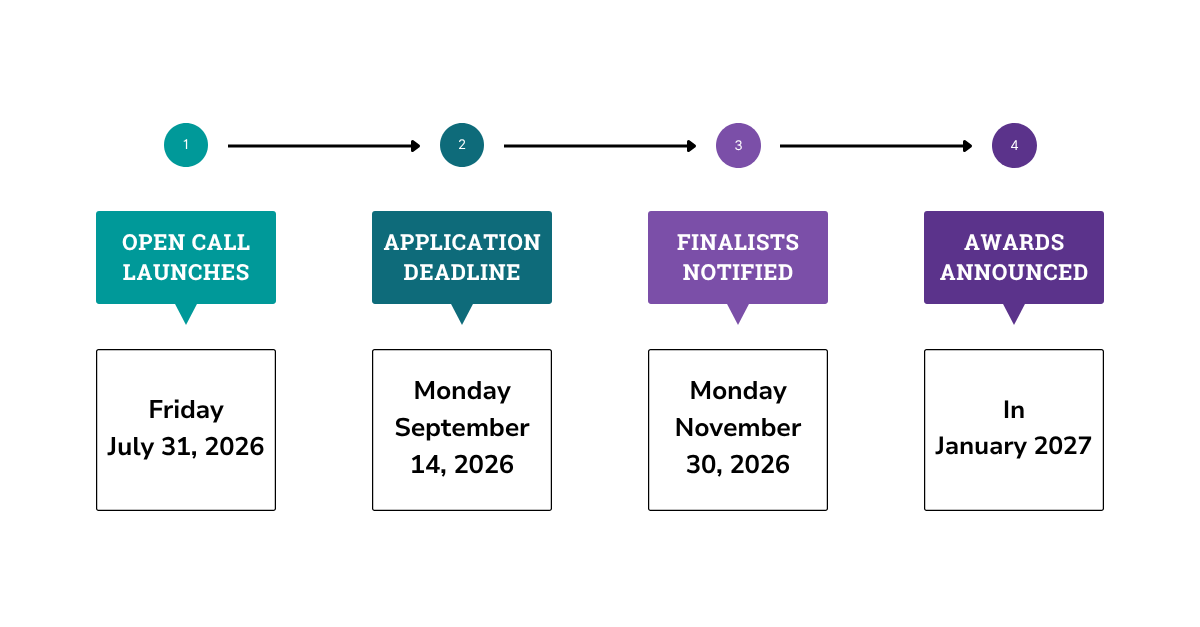
Applications will open on Friday, July 31, 2026, and are due by 11:59 p.m. ET on Monday, September 14, 2026.
All applicants, whether selected as a finalist or not, will be notified of their application status by Monday, November 30, 2026.
Award announcements are anticipated in January 2027.
The application will ask organizations to provide information about their organization, current postsecondary work, finances, proposed model, and expected outcomes.
Applicants will also be asked to provide information about:
Applicants will also be asked to upload organizational documents, including proof of legal status and a current organizational budget. Additional learner outcome or program evaluation data may be submitted if available.
Yes. The full application questions are available as part of the RFP preview.
View the full RFP and application form.
Applications must be submitted through the online application form by 11:59 p.m. ET on Monday, September 14, 2026.
Applicants will be asked whether they authorize Panorama Global to share their application, in whole or in part, with other potential funders that may have aligned interests in the proposed work.
This information may help identify additional funding or partnership opportunities that could support or complement the proposed work.
Sign up to receive occasional email updates about the IPM Fund.
For questions about the RFP or application process, please contact [email protected].
 Your Vision
 Our Platform
 Real impact
Panorama Global is a member of The Panorama Group.
Privacy Policy © 2026 Panorama Global. All rights reserved.
 Contact Us
 Search
 Join Our Mailing List