
 Knowledge CenterArticlesUnderstanding MacKenzie Scott's Decembe… Understanding MacKenzie…
Panorama Global’s Collaborative Learning from Impact Philanthropy initiative analyzes and shares learnings from across the field of impact philanthropy. We examine MacKenzie Scott’s giving and its effects on nonprofits to help shift norms and practices that advance social change.
About this analysis
Over the past four years, Panorama Global has published infographics and in-depth analyses highlighting key takeaways and trends from MacKenzie Scott’s giving through the Collaborative Learning for Impact Philanthropy initiative. Leveraging self-reported details from recipient organizations—including type of work (thematic focus areas) and where grantees work (geographies of service)—we analyze and document Scott’s giving - and its effects - to help shift norms and practices that advance social change.
Methodology
This analysis was based on the data about Scott’s 2,700 gifts publicly available on the Yield Giving website. It is important to note that self-reported data, like the focus areas and geographies of service listed in Yield Giving, has inherent limitations. Additionally, Scott grant recipients were given the option to delay disclosure of grant amounts, therefore approximately 45% of the grants in the December 2025 round have not reported gift amounts.
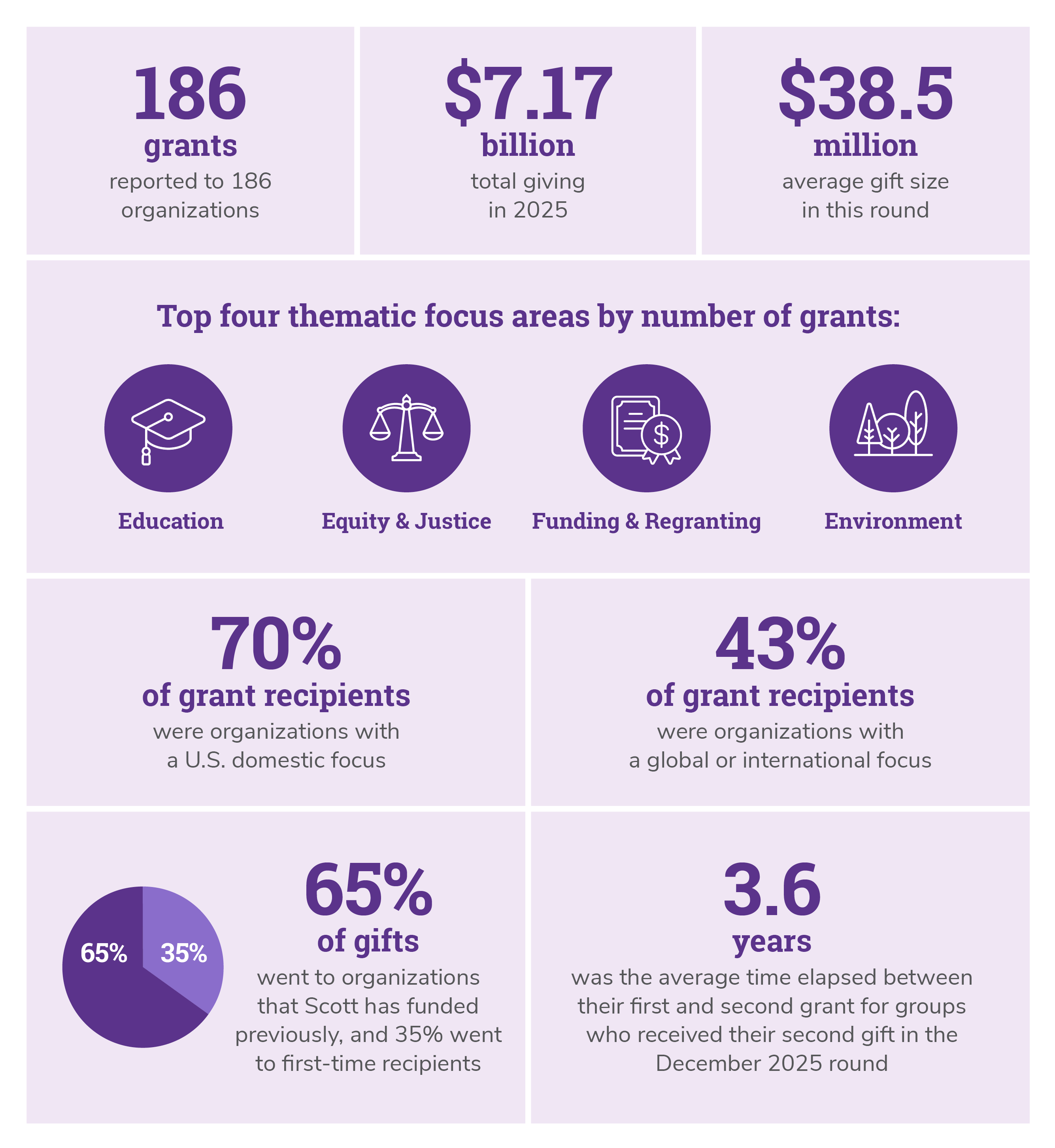
MacKenzie Scott is quietly - yet boldly - rewriting the rules of philanthropy, and the entire field should be paying close attention. Scott has given over $26 billion via 2,700 unrestricted grants since 2019, 186 of which were announced in December 2025.
The December 2025 giving round stands out in several ways. With $7.17 billion awarded across 186 grants, this is Scott’s largest single-round giving to date in terms of funds distributed, despite fewer grants than in previous years. 2025 also shows a clear move toward repeat giving at scale. For the first time, more grants went to organizations that Scott had previously supported than to first-time recipients. Repeat gifts are larger on average and continue to grow with each subsequent award.
This round also marks the first time the top thematic focus areas have changed in six years, alongside an expanding global footprint. The emergence of Funding & Regranting and Environment as breakout top priorities, alongside a growing global focus, suggests that while Scott values consistency in her giving strategy, she is also responding to fluid global political, economic, social and cultural shifts that have hindered the nonprofit sector’s ability to support the most vulnerable populations worldwide.
Taken together, the trends in the December 2025 giving round indicate that Scott isn’t just giving more; she’s modeling how scale plus sustained support can reshape what’s possible.
Panorama Global is pleased to present a deep dive into the patterns and trends from the latest tranche of Scott gifts, announced in December 2025. Keep reading for high-level takeaways and key insights on what the data tells us about Scott’s largest giving year to date.
1. 2025 was Scott’s largest giving year to date. In 2025, Scott gave away her largest amount to date, $7.17B. At the same time, the number of grants awarded in this round was smaller than in prior years. Taken together, these trends indicate that Scott is making more targeted, but increasingly substantial investments in organizations aligned with her giving priorities.
2. The windfalls are getting windier. Scott appears increasingly comfortable making larger grants. The average gift size in this round was the highest to date, at $38.5 million. This year’s increase also reflects broadly higher grant amounts across the board, when compared to previous giving years.
3. Top thematic focus areas shifted. For the first time in six years, Scott’s thematic areas shifted, with the themes of Funding & Regranting and Environment emerging as priority themes this year, alongside a continued emphasis on Education and Equity & Justice, two areas that have historically been priorities for Scott.
4. More grants to organizations with a global focus. This geographic widening comes at a critical moment for international humanitarian and social justice nonprofit organizations worldwide, many of which are coping with the fallout of the dismantling of the United States Agency for International Development in 2025, alongside other shocks to the global philanthropic landscape. In December 2025, 43% of the 186 groups funded were internationally focused, up from just 18% of Scott’s cumulative gifts from 2019–2024. While the majority of grants still went to U.S.-based organizations, this represents a notable shift toward global focus.
5. Repeat gifts have significantly increased. Scott is shifting away from primarily funding new organizations and is moving towards embracing repeat gifts to organizations who remain aligned with her giving priorities. Whereas only 18% of gifts in the December 2024 round went to prior recipients, nearly 65% of this year’s grants were awarded to organizations she has funded before. On average, 3.6 years elapse between an organization’s first and second grant.
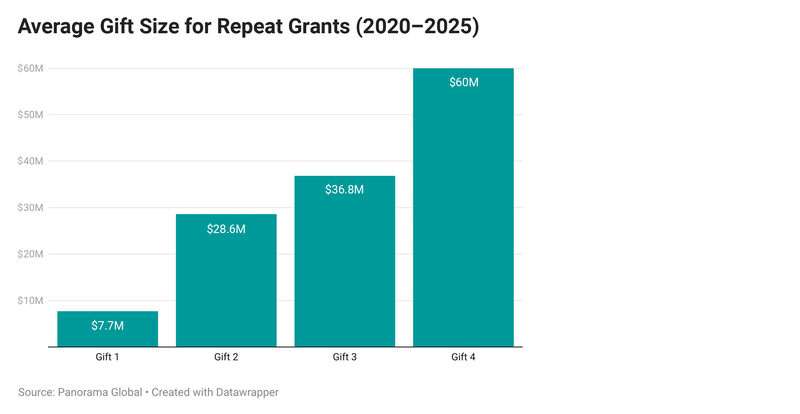
6. Repeat gifts are bigger. When Scott makes repeat gifts, the gifts get significantly bigger. On average, second time grants are more than three times the size of initial awards, with third- and fourth-time grants increasing even further in size.
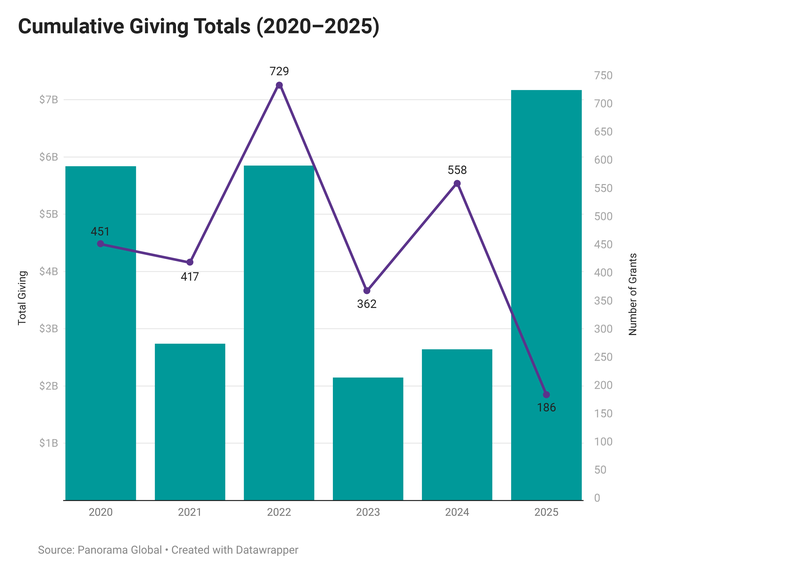
In terms of total dollars distributed, 2025 is Scott’s largest giving year to date, with $7.17 billion in gifts awarded. This impressive level of giving was achieved despite a smaller number of grants awarded than in prior rounds, reflecting a change in how funds are being allocated. The chart below illustrates how 2025 stacks up against Scott’s giving in previous years, in terms of number of grants as well as the total amount of funding distributed each year.
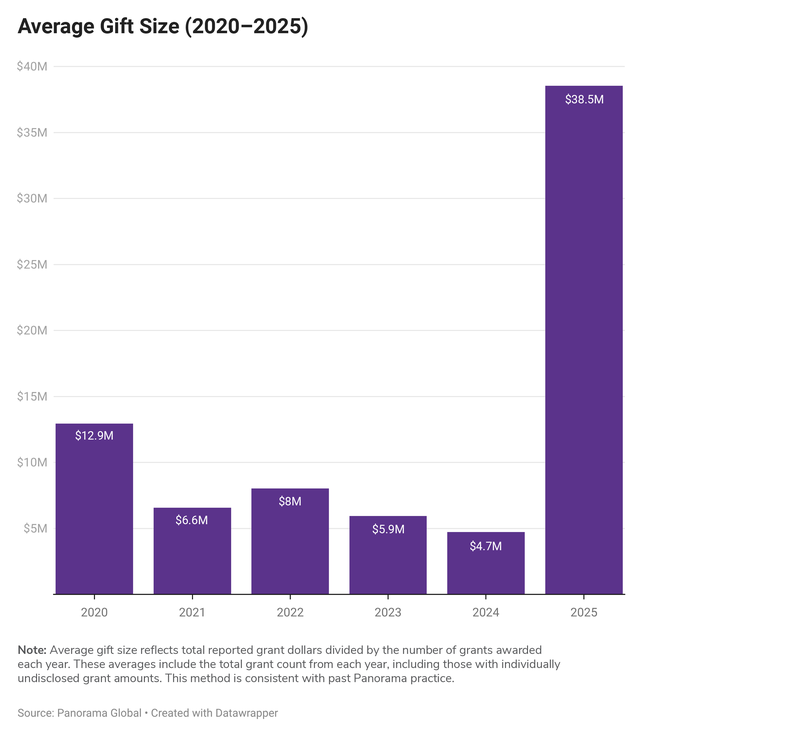
Not only did Scott have her biggest funding year yet, but the average gift size is also larger than it has ever been. Among the 103 grants with disclosed amounts*, the average grant size was approximately $33.7 million. When all 186 grants are included (including those with an undisclosed grant amount), the average gift size rises to $38.5 million, the highest average observed when compared with annual averages from 2020–2024.
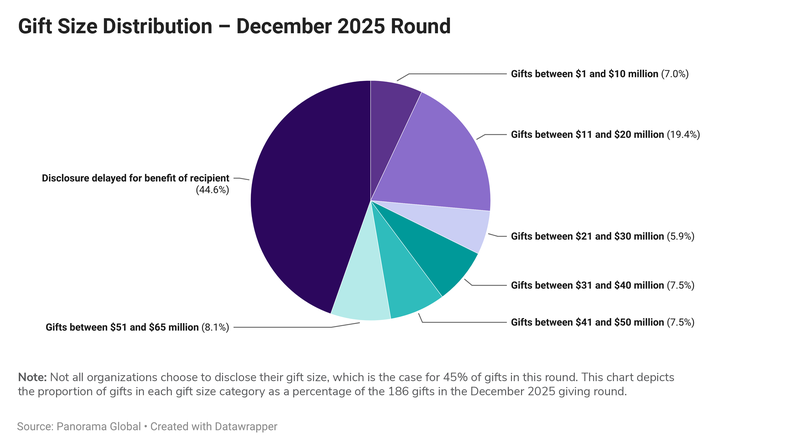
Gift sizes increased across the board, not just on average. Panorama’s 2024 analysis found that 58% of organizations received grants between $1–10 million in the December 2024 giving round. By contrast, grants in this same range accounted for just 7% of awards in the December 2025 round. This round, gift sizes were much more evenly distributed across the entire spectrum, with the largest share of awards falling in the $11–20 million range (19%). An additional 29% of awards landed in the $21–65 million range. This distribution demonstrates that the increase in average gift size is driven by higher gift sizes across the board, rather than a small number of unusually large awards.
For the first time, Scott awarded more grants to repeat recipients than to new recipients. Of the 186 grants awarded, 65% went to organizations she has funded before, while 35% went to new recipients. This is a substantial increase in repeat giving from the December 2024 round, when only 18% of gifts went to repeat recipients.
Most repeat gifts in this giving round were second-time grants. Further, amongst organizations who received their second award in this round, an average of 3.6 years passed between their first and second Scott gifts.
The size of repeat gifts is also much larger. Second-time grants were on average more than three times the size of the initial award. Third- and fourth-time grants continued in this pattern, increasing in size with each subsequent grant an organization received. The graph below analyzes Scott’s cumulative giving to date, showing the average grant size if the award is a first, second, third, or fourth-time grant.
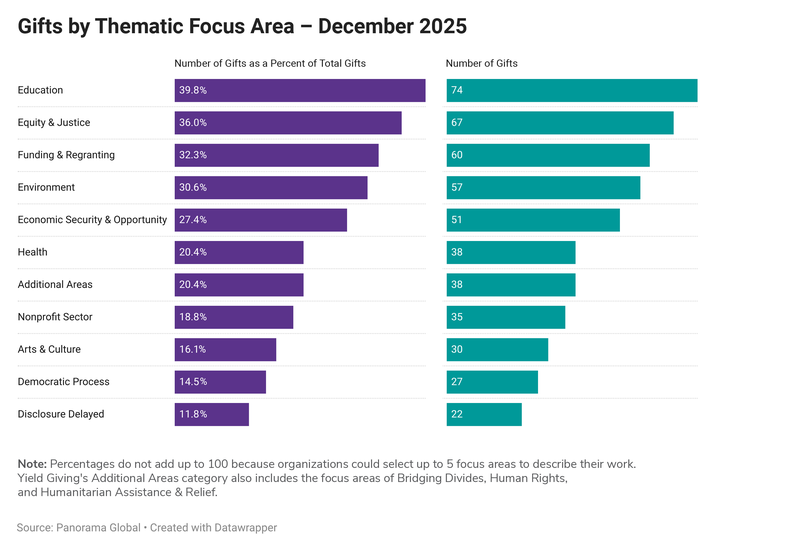
Scott’s top four thematic focus areas have changed for the first time in six years. In 2025, the leading focus areas by number of grants were Education, Equity & Justice, Funding & Regranting, and Environment. The elevation of these two thematic areas demonstrates that Scott may be employing new strategies, such as supporting intermediary funds to amplify the impact and reach of her grant dollars.
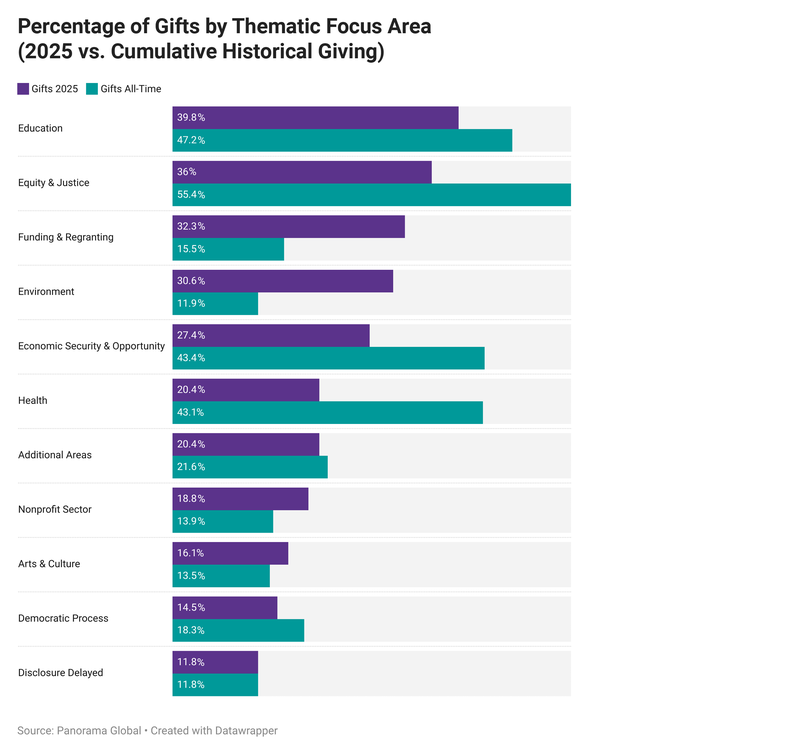
This shift in priorities is a notable change from Scott’s previous giving. From 2020 to 2024, the top four thematic focus areas remained consistent, although specific rankings and grant amounts changed slightly year over year. Of the four original priority themes, Education and Equity & Justice continue to appear among Scott’s top focus areas this round. By contrast, Funding & Regranting and Environment appearing in the top four represents a significant change, since these areas have usually appeared in the bottom half of rankings in previous years. The graph below illustrates how priority themes in 2025 compare to Scott’s cumulative historical giving patterns.
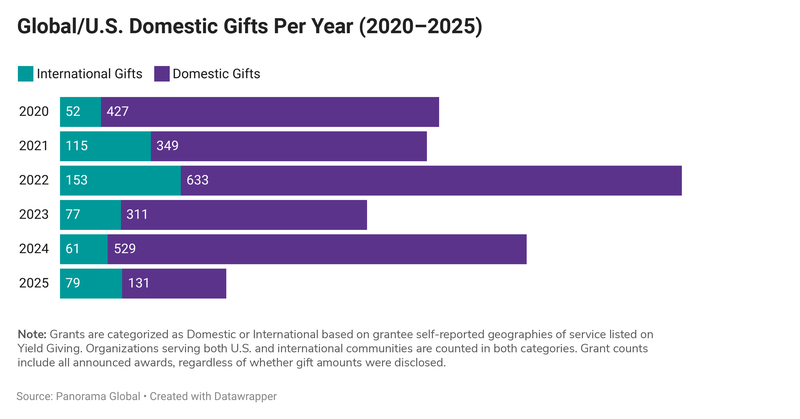
This giving round had the highest proportion of globally focused organizations to date. Out of 186 total grants, 43% went to groups with a primary geography of service outside the U.S., while 70% went to organizations with a U.S. domestic geography of service. This marks a shift from past years, where globally focused grants have represented a much smaller proportion of Scott’s overall annual gift count, as depicted in the graph below. (As a reminder, organizations can self-select multiple geographies of service).
The South and Mid-Atlantic regions received the largest number of grants (43%) amongst organizations with a U.S. domestic geography of service, with smaller shares going to the West, Midwest, and Northeast. The West has received the greatest share of grants in previous years and comes in only slightly behind the South and Mid-Atlantic region this round, receiving 32.8% of domestic gifts. Although this represents a slight shift, it is not significant enough to suggest a major shift in U.S. giving.
Sub-Saharan Africa received the largest proportion of grants (25%) amongst organizations with a global geography of service this round. Latin America followed at 22%. These figures remain largely consistent with Scott’s existing global giving trends, which have prioritized gifts to these two regions.
I. Executive Summary
II. Concentrated Giving
III. Repeat Gifts
IV. Thematic Focus Areas
V. Geographic Focus Areas
Download this report
Panorama Global is a social impact nonprofit that works with bold leaders to tackle the world's most urgent, complex problems. We help move capital, build coalitions, clear barriers for changemakers, and share knowledge to advance social change.
Be the first to receive Panorama’s latest research and publications. Subscribe to our newsletter here!
 Your Vision
 Our Platform
 Real impact
Panorama Global is a member of The Panorama Group.
Privacy Policy © 2026 Panorama Global. All rights reserved.
 Contact Us
 Search
 Join Our Mailing List