
 Knowledge CenterArticlesFrom Vision to Law: How Washington Thri… From Vision to Law: How…
Anxiety, depression, substance use, trauma. Everyone knows someone living with behavioral health challenges. More than one in five adults — an estimated 61.5 million people across the U.S. — experienced a behavioral health challenge in 2024. Among U.S. youth aged 6-17, more than one in seven (16.5%) experienced a mental health disorder in 2016.
For Mental Health Awareness Month, Panorama is spotlighting one of our sponsored projects, Behavioral Health Catalyst (BHC), which is working to implement a landmark initiative for youth and young adult behavioral health in Washington State.
We spoke with BHC’s Executive Director, Katherine Switz, about the systems-change effort behind Washington Thriving.
Behavioral Health Catalyst (BHC) launched in 2022 as a donor collaborative, bringing together a network of 50 funders focused on behavioral health and well-being. Our mission is to improve behavioral health prevention, support, and care so that people at risk of, or living with, behavioral health challenges can thrive.
We take a two-track approach: pursuing short-term opportunities for immediate impact alongside longer-term, system-changing work. In 2023, with philanthropic support, we partnered with Washington State to develop a strategic plan for children and youth behavioral health — what became the Washington Thriving Strategic Plan. BHC is now leading a public-private partnership that brings together philanthropists, policymakers, and community to work towards our vision.
Washington State is ranked 48th in the nation for youth flourishing — a metric indicative of the comprehensive well-being of our children — despite investments to increase access to behavioral health care. The data behind that ranking is sobering: roughly one-quarter to one-third of middle and high school students report depression symptoms or high anxiety. Only about half of youth and young adults on Medicaid receive the mental health treatment they need — and just one in three gets substance use services when needed.
The root cause isn't a lack of caring — it's a system that was designed for adults, is reactive rather than proactive, and is fragmented in ways that create barriers for youth at every turn. Turnover rates for the behavioral health workforce in Washington run as high as 40% annually. The number of young people needing intensive care doubled between 2018 and 2023, yet the state has fewer pediatric inpatient beds per capita than the national average.
Washington Thriving exists to address these barriers for youth and young adults. It was co-developed with young adults, families, providers, state agencies, and advocates, and it envisions a future of equitable access and outcomes for all.
The years before birth through age 25 are when the foundations for lifelong well-being are built — and also when serious mental illness is most likely to emerge. These are precisely the years when prevention and early intervention are most effective, before challenges become more severe or create lasting consequences.
A behavioral health system that genuinely supports young Washingtonians doesn't just improve their lives, it creates a generational ripple effect.
In November 2025, BHC facilitated the creation and submission of the Washington Thriving Strategic Plan to the Washington State Legislature, drawing on input from more than 300 stakeholders. The plan was unanimously approved by the Legislature, with a call for a state-level Executive Coordinator to lead implementation. Our funder collaborative members pledged $450,000 to fund that role.
In March 2026, Governor Bob Ferguson signed HB2429 into law, codifying Washington Thriving and officially creating the Executive Coordinator position in the Governor's Office. That's a remarkable arc: from vision into state law in just a few years.
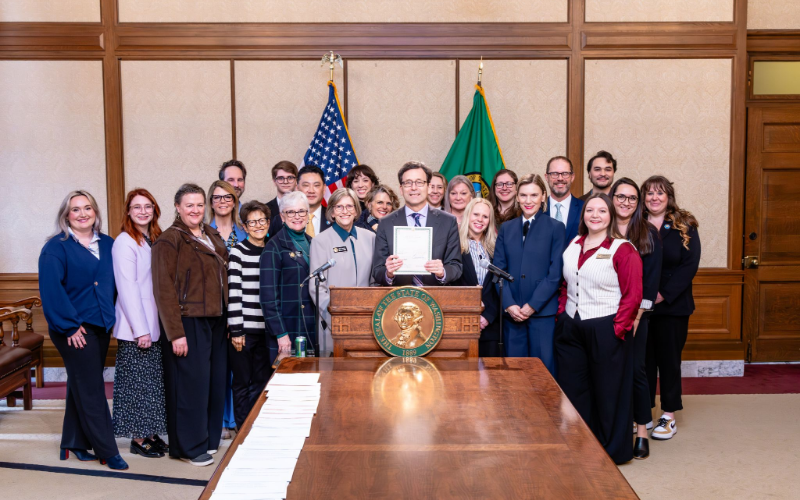
Governor Bob Ferguson signed HB2429 into law in March 2026. Photo provided by Behavioral Health Catalyst.
BHC is now working closely with the Governor's Office to launch a Leadership Council that will guide statewide implementation of Washington Thriving, and to support the Executive Coordinator as they manage collaboration across agencies and partners. The plan identifies four priority initiatives to address critical needs and build early momentum: System of Care Infrastructure, Supports for Perinatal Well-Being, K–12 Student Behavioral Health, and Treatment Services Expansion.
We're currently diving into early-stage collaborative efforts on perinatal well-being and K–12 student behavioral health in partnership with UW CoLab and Bloom Works. The systems-change work is just beginning, and we’re energized by what's ahead.
Are you a funder passionate about behavioral health issues? Contact Katherine Switz at [email protected] to learn more about joining BHC’s funder collaborative.
Interested in learning more about Washington Thriving? Reach out to the BHC team at [email protected] or the Washington Thriving Project team directly at [email protected].
Behavioral Health Catalyst is a fiscally sponsored project of Panorama Global. Learn more at bhcollaborative.org.
Panorama Global is a social impact nonprofit that works with bold leaders to tackle the world's most urgent, complex problems. We help move capital, build coalitions, clear barriers for changemakers, and share knowledge to advance social change.
Be the first to receive Panorama Global’s latest research and publications. Subscribe to our newsletter here!
 Your Vision
 Our Platform
 Real impact
Panorama Global is a member of The Panorama Group.
Privacy Policy © 2026 Panorama Global. All rights reserved.
 Contact Us
 Search
 Join Our Mailing List