
 Knowledge CenterArticlesCase Study: Amref Health Africa Case Study: Amref Healt…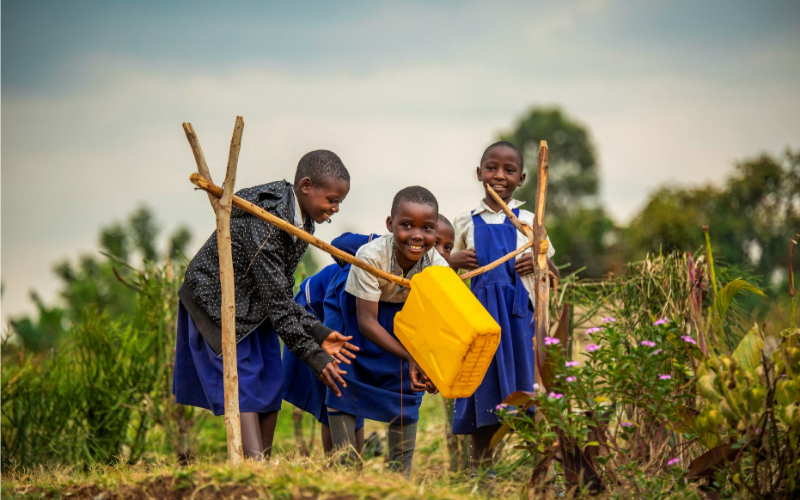
Members of the Sanitation Club at St. Peter and Paul Primary School, Bunyagabu District, Western Uganda, demonstrate how a tippy tap works. © Amref Health Africa / Ambrose Watanda
Amref Health Africa, the continent’s largest Africa-based health development organization, operates across a wide regional landscape, implementing more than 180 programs in 35 African countries and reaching 40 million people annually.
With 10 program offices across Africa and 10 resource mobilization offices in Europe and North America, we operate at a scale that few Africa-led organizations have achieved—and at a moment when that scale is being tested.
The global health funding landscape is contracting. Traditional donor dependency is a structural risk. The MacKenzie Scott gift arrived at exactly this moment—and we used it to fundamentally change how we are built.
We made two bets with the Scott gift. The first: $10M into a fundraising investment fund to build our own donor base. In two years, annual unrestricted income from individual donors jumped from $1M to nearly $6M—with total projected returns of $19M. One unrestricted dollar became six. That is what financial autonomy looks like in practice.
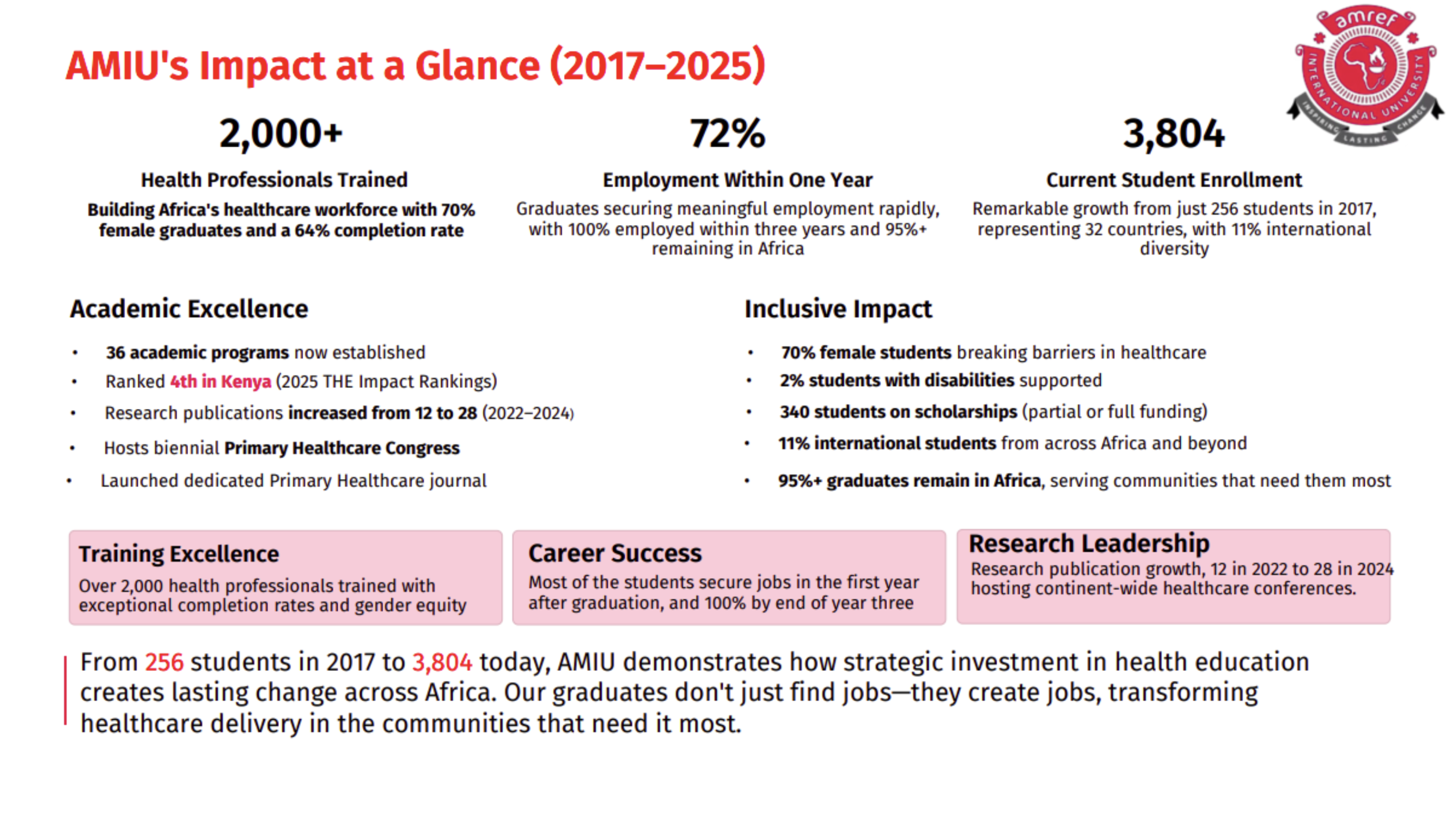
The second bet was structural. We had launched Amref International University in 2017 but stalled on accreditation because our infrastructure did not meet Kenya’s standards. We used $25M—half the Scott gift—to build the first phase of a campus designed to train 3,000 health professionals.
This investment unlocked a 50-acre land gift from former President Uhuru Kenyatta and co-financing from Proparco to support further expansion.
The results are not abstract: over 2,000 health professionals trained, 70% women, more than 95% staying in Africa. Enrollment growth has expanded academic and research programs, supported by inclusive scholarships. Africa is training its own health workforce—on African terms.
Unrestricted capital is not a gift without guardrails; it is a bet on leadership. When funders trust locally led organizations to make strategic decisions, those organizations can move fast, take calculated risks, and build for permanence rather than project cycles.
The MacKenzie Scott gift did not simply fund our programs; it funded our future. This catalytic investment transformed our ability to innovate, lead, and respond to changing landscapes. It offers a blueprint for how catalytic philanthropy can accelerate autonomy and systemic change.
Our experience demonstrates how philanthropy, when strategically deployed, transforms dependency into independence and seeds lasting impact across Africa.
© Amref Health Africa
Download this case study
For more, see our report What Flexible Funding Makes Possible: How Global South Organizations Leveraged Funding from MacKenzie Scott to Sustain Impact in Turbulent Times.
 Your Vision
 Our Platform
 Real impact
Panorama Global is a member of The Panorama Group.
Privacy Policy © 2026 Panorama Global. All rights reserved.
 Contact Us
 Search
 Join Our Mailing List